
Edited on 26-Jan-10 to correct the errors that Dr. Bonilla-Warford pointed out (thanks Nate!) – Ann Z
Glasses prescriptions can be confusing – lots of numbers and abbreviations that aren’t necessarily easy to figure out, or at least, they weren’t when I first tried to understand Zoe’s prescription. And in fact, I thought I understood what all the numbers meant, but after doing more research for this post, I found it to be far more complex than I’d originally thought. (On that note, if any eye doctor types read this and catch any mistakes, please, please let me know and I’ll correct them).
Before we get too far into what a prescription is, I thought it might be worthwhile to mention what a prescription isn’t. It will not tell you:
- what your child’s diagnosis is. You can tell whether glasses will correct for nearsightedness or farsightedness, but that doesn’t tell you what the cause of the vision problem is.
- your child’s visual acuity, that is, how well your child sees (either with glasses or without them).
- if your child has strabismus, it will not tell you how much his or her eyes are turning in or out.
- how well your child’s eyes work together, and whether or not he or she has stereoscopic vision.
- how advanced your child’s cataracts or glaucoma is, and how that affects their vision.
- anything that is not related to how glasses or contacts should be made in order to correct your child’s refractive errors (that is, due to the shape of the eye not being able to focus light correctly).
Okay, so back to the eyeglasses prescription then, and what it can tell you. Prescriptions have a lot of different components, and I’ve seen them written a number of different ways, but they do have common elements at the core. I’ll go into more detail on each piece, but I tried to put together something of a “cheat sheet” here:

Which eye are we talking about?
Since we’re nearly always looking at prescriptions for two eyes, you’ll nearly always see two sets of numbers, one for the left eye, and one for the right. I’ve seen some prescriptions that label them “left” and “right” or “l” and “r”, which even I can figure out on my own. But more often, I’ve seen “O.D.” and “O.S.”. These are abbreviations for the Latin words for left eye and right eye. For the record:
- O.D. : right eye
- O.S. : left eye
- O.U. (which I’ve never seen before, but found this information so figured I’d include it) : both eyes
Sphere
Sphere, often abbreviated as “sph” is the spherical refractive error, or nearsightedness or farsightedness. The first part of this number will be a plus or minus sign:
- + : farsighted, or longsighted prescription: hyperopia.
- – : nearsighted, or shortsighted prescription: myopia.
- 0, Pl, or Plano : no error
How strong is the spherical prescription?
The number is in “diopters” but we don’t need to know too much about that (read about it on Wikipedia here), it’s a measure of how much the curvature of the eye is off from normal. Basically, the higher the number (ignoring the plus or minus), the stronger the prescription.
Myopia (-)
- 0.00 to -3.00 : mild myopia
- -3.00 to -6.00 : moderate myopia
- -6.00 and higher : high myopia
Hyperopia (+)
- 0.00 to +2.25 : mild hyperopia
- +2.25 to +5.00 : moderate hyperopia
- +5.00 and higher : high hyperopia
Cylinder
Cylinder is the measure of astigmatism. Astigmatism is when there’s an irregular shape to the cornea, often described as an oval shape (if you’re in the US, think the shape of a football, if you’re other places, think the shape of a rugby ball). It causes blurriness at any distance. There are two measurements that go along with astigmatism, the first, cylinder, is a measure of how severe the astigmatism is.
How strong is the cylinder prescription?
Like the spherical error, the cylinder number is measured in diopters. The thing you want to pay attention to is the number. The higher the number after the plus or minus, the more severe the astigmatism.
- 0.00 to 1.00 : mild astigmatism
- 1.00 to 2.00 : moderate astigmatism
- 2.00 to 3.00 : severe astigmatism
- 3.00 and higher : extreme astigmatism
Note: The cylinder may be written as a plus or a minus, but that doesn’t actually make any difference in how bad the prescription is, ophthalmologists use a “+”, optometrists use a “-“. You can use an online cylinder conversion tool or convert on your own by 1) adding the cylinder power to the sphere power; 2) Changing the sign of the cylinder:- if +, then use -, if – use plus; 3) Add 90 degrees to the axis if it’s less than 90 or subtract 90 if it’s greater than 90.
Axis
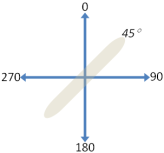
The axis tells you which way the astigmatism is oriented on your child’s eye
If you think of astigmatism as an oval shape, it makes sense that the oval might be turned any direction. The axis number then, tells you the orientation of the astigmatism. The number is in degrees, it doesn’t have anything to do with how severe the astigmatism is, just how it is situated on your child’s eye.
Add
If your child needs bifocals, you will likely see a number here. This tells you how the prescription should be changed for close up. Let’s say your child has a regular glasses prescription of +3.00, if the add number is +1.00, then the near distance prescription will be +3.00 + 1.00, which equals +4.00 (3+1=4). In the same vein, if your child is nearsighted, say -4.00, but has an add of +2.00, then the near distance part of the bifocals will have a prescription of -4.00 + 2.00, which equals -2.00.
Sometimes, you don’t have an “Add” part of the prescription, and instead you’ll just see a prescriptions for distance vision and a separate prescription for near vision.
But what does that mean for how my child sees?
If you’re wondering what your child’s prescription means in terms of how they can see, there are a couple of places online where you can plug them in to see how blurry things appear. Keep in mind that an eyeglasses prescription is not the final word in how well a child sees. For instance, it will not tell you how your child’s weak eye is seeing if your child has amblyopia, or how your child might be seeing if he or she has cataracts or glaucoma.
Take a look at our guide to online vision simulators for more information.
 For Little Eyes
This is marvelous, Ann. A really great reference for parents.
A few notes:
OD = right eye (Latin – Oculus Dexter)
OS = left eye (Oculus Sinister)
OU = both eyes Oculus Uterque)
I see that you have this, but it is incorrect on the Ex diagram. Also out of convention the OD is always listed first/on top.
One of the most confusing things to patients is that for cylinder (cyl), plus or minus is NOT an indication of the visual problem that the patient has, but is purely convention. MDs use plus and ODs use minus. This in itself would not be a big deal, except that it changes the other numbers, and it patients can think there is a change when there really isn’t.
Example: First eval (MD) +4.50 +2.00 X 090. Second eval (OD)+ 6.50 -2.00 X 180
Parent: Oh! Her eyes have gotten so much worse!
OD: No, don’t worry is exactly the same. Here, let me show you. This is how you convert between MD and OD glasses prescriptions.
1. Add the cylinder power to the sphere power
2. Change the sign of the cyl (if +, then use -, if – use plus)
3. Add 90 degrees to the axis is less than 90 or subtract 90 if the original axis is greater than 90.
This even trips up opticians, and is one of those little quirks of convention.
I hope this is helpful.
LikeLike
Thanks Nate! I caught the left vs right in my text last night, but forgot to check to make sure the figure was right. Oops. I’ll have to fix that when I get home.
I read an explanation of the astigmatism differences in how they’re written, but I didn’t understand it well enough to explain it myself, so thank you for the clarification on that, too.
LikeLike
If you are redoing the diagram anyway, here’s another little nit-picky thing: sphere and cyl always go to 2 decimal places and the axis is always in three digits. So it is “+4.00 +1.50 X 090” not “+4.0 +1.5 X 90”
Not trying to be a pest, but I figured that since this is a post on the spectacle Rx, it should be consistent.
LikeLike
Thank you so much! For clarifying this. This is exactly how my child’s prescription is written. If it wasn’t for your comment I would not have been able to figure out which was the axis.
LikeLike
My nephew’s (he is 11) eye Dr. discovered he has very bad eye sight. He was encouraged to get glasses at a lesser prescription to start in order to help his eyes to adjust to wearing such a strong prescription. Is this a common practice or a money grab?
LikeLike
Hello! Yes, that’s something that some eye doctors will do, it can help a kid get used to their new prescription.
LikeLike
My child’s eye exam says this:
O.D. : Sphere= 0.00 Cylinder= -1.00 Axis=102 PD= 56.50
O.S. : Sphere= 0.00 Cylinder= -0.75 Axis= 068 PD= 53.50
Does this mean that she is nearsighted or farsighted, astigmatic or not, and does she actually need glasses?
It seems very confusing.
LikeLike
Hi Casey,
It is confusing. The prescription shows astigmatism in both eyes, with the right eye having a very slightly stronger astigmatism. As for whether she needs glasses, that’s not something I can answer. Did her eye doctor recommend glasses?
LikeLike
This is awesome – thanks. And thanks to Nathan for explaining the MD/OD prescription thing – I was wondering why my last prescription looked so different from the previous one (and the doc didn’t bother to explain, she just said that my new glasses were almost the same as my old ones).
LikeLiked by 1 person
This is great Ann, thanks! I have a much better understanding of Emma’s prescription now….
LikeLike
So helpful! THANK YOU!!!
LikeLike
Hi all,
Speaking of scripts, I am very pleased to announce that we had our appointment with the PO for Paris today and her script has not changed it is nice and stable and her vision has improved from 3/18 to 3/12 in her amblyopic eye so it was very good news all round. We have to continue what we are doing, wearing the glases all the time and patching two hours and he does not need to see us for another six months. Needless to say we were so so happy that the work is paying off. Nate I also wanted to ask you about Paris’s script – she is right eye -4.5l/+1/90 and the left eye plano. Do you think with such a big difference contacts would be a better option? She is two. PO seemed to think when she is 8-10 years old but I have read some interesting reports on contacts being a better option even at this young age? Many thanks.
LikeLike
sorry that should have read
-4.5 – 1- 90 for her script
LikeLike
Ingrid, have you seen Dr. Bonilla-Warford’s post on young children and contact http://www.brighteyesnews.com/2008/06/14/ask-dr-b-can-babies-really-use-contact-lenses/ ? It mentions that very different prescriptions in the two eyes can be a reason for contacts. There’s also a recent post showing how one family gets the contacts into their child’s eyes http://www.brighteyesnews.com/2010/01/26/toddlers-can-use-contacts-video/
LikeLike
I’ve often mused over what Nicholas does see. After reading through all of the information above, and running the simulation, I have to admit I’m equal parts intrigued, scared, and proud. This simulation ends at -6, however N’s rx is well past the scale(-7.5 OS, -18 OD). I’m left thinking..wow..if -6 is..well wow, then what does/ how does he see at the above numbers?? He does quite well in fact..both with and without the glasses..though extrapolating the scale of the simulation the reality must be..something north of wow. I’m left nothing short of amazed at what he..all our kids…are able to overcome. Incredible stuff.
LikeLike
Hi George, is there a way I can contact you directly. My daughter has high Anisometropia, similar numbers to your sons, although due to a different reason. I wanted some advice. Being a lot like you, I have researched and researched and researched. I just want someone to put some perspective on things, somebody who has been there. I’d really appreciate it.
LikeLike
it sure is George, I thought the same. At -4.5 it was pretty bad on the simulation! Amazing is right, what children can overcome is inspiring.
LikeLike
My son was just recently diagnosed with astigmatism related bilateral amblyopia. I have been trying for two days to decifer the RX before our 1st appt with the opthalmologist. I can now put his script into context. His Cy is 3.25, so while maybe not as bad as it could be it still falls in the extreme range. Thanks a million!
LikeLike
Hi Melissa –
I came across this site and saw your comment about your son being diagnosed with astigmatism related bilateral amblyopia. My 3 yr old was recently diagnosed with the same condition and prescribed glasses. (4.50 astigmatism both eyes, but his prescription was for 3.75. )I was wondering how old your son was at diagnosis. What made you bring him to get his eyes checked? Whether or not he has been corrected to 20/20 with the glasses. And, if his Dr. has told you what the prognosis is for his visual future. Any information would be greatly appreciated. Thank you.
LikeLike
Hi Melissa,
My 3 yr old was tested today and her left eye is 3.75. I was wondering if your son’s eyesight has improved since wearing glasses? what has been your experience?
LikeLike
I notice young kids with high magnifying glasses, and even bifocals. Is there a reason for this? Lots of hyperopic kids out there? I’m mildly nearsighted so I wonder what it’s like for farsighted people out there. Do you see clear far away or is far away even blurry rendering you helpless without your glasses? Why do some need bifocals and others not? Years ago, at my junior high school around 1987 there was a teen girl with strong magnifying bifocals in larger clear plastic frames who I didn’t know real well, just passed her in the hall and coming out of a class. Her glasses must have been +6 or above I’m guessing. Is farsightedness more of an inconvenience than nearsightedness in terms of how it affects your life? Like could hyperopes survive a day without glasses? What would you do if you broke them and needed to drive to the eye dr but couldn’t wear them thus couldn’t you see well to even drive if farsighted?
LikeLike
Robert, yes, the majority of young children in glasses are hyperopic. Check out this simulation to see what that looks like: http://www.eyeland-design.com/webtools/53828496ca1045c06/53828496bd08b1006/index.html – as you get much beyond +3, you start losing detail even in the distance.
One of the big problems with hyperopia, especially in young children is that it causes eyestrain and can pull their eyes out of alignment. My daughter can function relatively well without glasses, she’s a +3.5, but she gets tired quickly and her eyes cross. That’s a big deal when they’re still developing stereoscopic vision and when they’re trying to learn to read.
As for what would someone with strong hyperopia do if they broke their glasses? Probably the same thing that someone with myopia does – wear a back up pair until they get them fixed.
LikeLike
hi i found your post very helpful but i was wondering, my son is 5 years old cy +10! i know…. strong!!! but we are working ourselves up to the right prescription! he is on +8.5 at the moment! 3rd pair! started at +5, will his eyesight ever get better? is there much chance of it deteriorating anymore? and what is the max a long sighted prescription goes to in strength?
LikeLike
Hi, don’t know if you will read this but my son is very farsighted and has prescription of +9.5 and +11.5! I was wondering if your child’s prescription has lessened in the last few years as I was hoping my son’s may improve slightly?
Thanks
LikeLike
My daughter just turned 9 and this summer at her eye appointment, her prescription finally decreased. It had been slowly increasing for the past 8 years, so I was thrilled that it’s gone down a little. I think it’s likely she’ll always need glasses, if only because she also has astigmatism. Many kids who are farsighted have their prescription decrease later in childhood.
LikeLike
I have a question about “PD” on the prescription which is pupillary distance ( I am sure everyone here knows that but just thought I’ll mention it anyways ). How important is the PD accuracy ? We had appointments with 2 Pediatric ophthalmologists regarding my son’s accomodative esotropia. One of then wrote the PD on the prescription while the other didnt and asked us to get it from the optician. When we went to get his glasses the optician insisted she would need to recheck the PD and not just go with what the doc had written down. Surprisingly it was way off – Docs PD was 55 and opticians PD was 51. She suggested we go with 52. I am concerned now. WHat are your thoughts ?
LikeLike
PD is an important measurement that effects the manufacturing of prescripiton eyeglasses. To understand the importantance you need to know a little more about how a prescription lens works.
Prescription Lenses are curved, not flat. The higher the prescription, the higher the curve. (Regardless of whether it’s + or -) The prescription that your Doctor writes for you is located in the center of the lens. (The “OC” or Optical Center) As you move away from the optical center, the prescription in the lens gets weaker. The amount of change as you move away from the optical center is greater the higher your prescription. Someone with a very weak prescription may not notice this change at all, while someone with a very high prescription will always notice it. (If you are wearing glasses, choose a word on your computer screen to focus on, and then move your head from side to side. You may notice a subtle change in clarity!)
To get the most accurate vision through your glasses, the optical center of your lens should always be directly in front of your eye. The PD measurement tells your glasses manufacturer where your eyes are so they can be sure to move the lenses optical center so that it lines up with your eyes.
In addition, Your eyes are very smart and want to see as clearly as possible. If the Optical center is not directly in front of your eyes, your eyes will actually turn towards it. This can be good or bad. If your eyes are currently straight, an offset OC can cause your eyes to turn and cause a lot of strain. If you have one or both eyes that turn in, or out, purposely offsetting the OC will incourage your eyes to turn towards the propper direction to help straighten them.
If your child has one or both eyes that turn, you may notice yet another piece to the prescription, called prism. It is usually indicated by a number (how much prism), followed by a triangle (the symbol for prism), and the word up, down, in, or out (or simply an arrow, indicating which direction the prism should go) If you see this on your child’s prescription, it means that you doctor wants their glasses to be made with the optical center moved, to help pull their eyes in the proper direction.
LikeLike
I guess I’m a little confused. My 6 and 8 year old were just diagnosed with moderate and severe farsightedness and astigmatism.
My 6 year old’s Rx is : O.D. +1.25, 1.25 cylinder (they are gradually going to increase the Rx so her eyes can adjust); O.S. is about the same
My 8 year old is worse and so far O.D. is + 2.5, cylinder -1.5 and O.S. +1.5, cylinder -0.75(again gradually increasing the Rx in probably 3 stages)
My confusion arises from the fact that neither had ever appeared to have any problems. They both learned to read well in kindergarten and have done well in school. If their eyes are supposedly so bad, how did they see to do their work?
The optometrist said that young kids’ eye muscles can adapt and let them see but causes a lot of strain. Is that possible?
LikeLike
Hi Amy! What your optometrist told you is exactly how I understand it. Farsightedness can be compensated for with the accommodative reflex. But it can lead to eyestrain and fatigue, and can even lead to the eyes crossing. Both of your children have mild to moderate farsightedness, and moderate astigmatism. As your kids get older, and the print they read gets smaller, they might have more problems focusing on their school work.
I hope that helps – If you’re still unsure, I’d recommend a second opinion.
LikeLike
Thanks so much for the information. This site is such a great resource!
Both my kids’ prescriptions that I listed are the ones they have now. Eventually, their prescriptions will be higher. The optometrist said my son falls into the severe category and my daughter is toward the tail end of the moderate category. That’s why it was hard for me to conceptualize that the muscles could accomodate enough for them to do as well as they have in school.
LikeLike
Ah, sorry, I understand now. I think a second opinion is warranted in your case. I’ll have to do some research to see just how much farsightedness can be compensated for by children. The astigmatism may also be relatively new – Zoe’s astigmatism jumped pretty significantly over a few months’ time.
LikeLike
I just wasn’t clear enough with my first post. Thanks for the info. My next question was actually going to be if I should get a second opinion. My pediatrician recommended a pediatric ophthalmologist and I guess I’ll take them there since it’s covered on my insurance. Sadly, we didn’t put them on our vision plan this year.
I was actually surprised they are farsighted. My husband’s eyes are perfect and my vision requires a -7 Rx so I figured my kids might be nearsighted but not farsighted.
Thanks again.
LikeLike
Thank you so much for this post. We just found out yesterday that our 4-year-old daughter has a pretty moderate astigmatism and will likely need glasses, but she’s going for a follow-up first before we get to that point. Our optometrist explained what she sees, but I have a much better idea now with the website links.
LikeLike
Thank you for this post, my 6 year old son has a strong prescription (OD+6.75 cylinder -125 axis 178 OS +8.25, cylinder -150, axis 172) and newly added ADD +2.75 so we are now looking at bifocals. For the last 4 years I have struggled trying to understand what it all means and how he may see.
Thank you!
LikeLike
Looking for an opinion: My son is far sighted, has strabismus, amblyopia and an astigmatism. He patches and he wears prescription eyewear to correct his vision. He is in kindergarten and would rather not wear glasses or patch, if he had a choice. Six months ago I went in to get a frame and lenses for him and when they filled the prescription, it was off +25 in the sphere and the lenses completely eliminated the astigatism portion of the prescription! On his follow up appointment today, to evaluate his eyes, they checked his prescription and realized it wasn’t correct. They are the one’s that filled it, however, and assured me that it wasn’t any big deal at all. In your view, is that pretty serious, to mess up a young child’s prescription? Would you find another opthamologist and view this as pretty negligent on their part? Or is it really common and not a big deal, as they tried to tell me?
His eyes are certainly not better so 6 months of wearing glasses consistently, completely wasted!
LikeLike
I would be pretty annoyed at that, especially not correcting the astigmatism portion. I do know that prescriptions can be off by a bit (that was the case with one of my daughter’s pairs), but I don’t know what the normal tolerance is for error like that. In any case, if you’re unhappy with them, then I would definitely find another place. I don’t think the six months were wasted, though. They did help correct his vision, and he was surely seeing better with his glasses than without them.
LikeLike
hi guys,i have question,my 6 yr old child has prescription his OD is -0.75 and OS -1.00,is it worst im just worried for him the doc didnt tell us anything so i dont have and idea..lol…U think wearing glasses will help him improve his eye sight?thanks
LikeLike
Hi Shei, those are mild nearsighted prescriptions. I like this simulator – http://www.eyeland-design.com/webtools/53828496ca1045c06/53828496bd08d7c0c/index.html – for seeing what it’s like to have that prescription. Wearing glasses will definitely correct his vision while the glasses are on, and that will help his vision develop correctly, but it won’t “cure” his nearsightedness, and he might need a stronger prescription as he gets older, that’s a totally normal thing in this case.
LikeLike
oh thank u very much for the info ann:)it make me lil worried that there is no cure…
LikeLike
I want to know what my child sees. Is there any site that can give parents an understanding of what the world looks like through little farsighted eyes which also have astigmatism?
LikeLike
Hey folks!! My nine year old is wearing glasses and her prescription just keeps getting so much worse!! its making me nervous. Should I be worried, what can I do? She started at like a -1.00 a few years back and now shes a -4.25. Bad vision runs in the family and I am a glasses wearer too, but my vision is not as bad as hers… Any ideas? Could their be something medical making it worse?
LikeLike
I asked an optometrist this once, and was told that they don’t really know what causes nearsightedness to get worse. There are some studies that have found a few treatments that seem to slow the progression: bifocals is one, orthokeratology (wearing rigid contacts at night to reshape the cornea) is another, though I haven’t done a lot of research on this. I do know that usually people’s prescription stabilizes in their early 20s (though mine continued to get worse until I was about 30). I would ask your daughter’s eye doctor, but my sense is that it’s not a medical issue that’s making her progression worse, just bad luck as it were.
I’d love to hear what your eye doctor says.
LikeLike
My son has just had a routine eye exam and is long-sighted. OD +1.75 and OS +2.75. They want him to wear glasses to help correct his vision and they seemed to suggest that after wearing glasses his eyesight would then improve and he might not need to wear them in the future. Is this likely? My son is 8 and very concerned about wearing glasses. If I can say it is temporary that would be great but I don’t want to give him false hope! Does anyone have experience or knowledge of this?
By the way he is an excellent reader and will read for long stretches, holding his book at a normal distance from his eyes without any problems so the far-sighted diagnosis was a surprise!
LikeLike
Hi Cathy, Kids do tend to outgrow at least some of their farsightedness as they get older. From my reading of the studies, children are more likely to not need glasses later on in life when the initial prescription is low, and they are first prescribed glasses at a later age. Both of which are true for your son, but gosh, if it were my, I think I wouldn’t tell him it’s temporary. I’ve gotten in trouble before promising things that I shouldn’t have promised. Has he picked out glasses yet? Do you think that he’ll feel better about the glasses if he has say in the style, especially if he finds glasses he likes?
Good luck!
LikeLike
This is really helpful, honestly after 4 years attending eye apts with my son, this is the easiest to understand. Thank you.
LikeLike
Thank you for this! So very helpful and makes me feel a little better to know that I am not the only one dealing with this. We just found out that our 18 months old needs glasses because he is very farsighted and his RIGHT EYE would go inward sometimes. His prescription is RIGHT +5.25 x -0.25 x 040 and LEFT +3.75 x -0.25 x 145. It just hurts my heart to think/know that my son is having vision problems. I made an appointment with another pediatric ophthalmologist for a second opinion just to get a confirmation.
LikeLike
Thank you so much. This was VERY helpful!
LikeLike
What percentage can I see if I have -OS 7.5 lenses ? My little one is 4 yrs old
LikeLike
I am a bit confused, the PO at the hospital said that my daughter is mildly myopic with a minor astigmatism, and mentioned something at her last appointment about wearing her glasses for homework, but she still wears her glasses all the time – does she need to? Her prescription is -1.00 sph with -.075 cyl on a 90 degree for both eyes. My current prescription is worse than this but I only wear my glasses to drive and watch TV. Her next appointment isn’t for 3 months so I’m a bit confused as to whether she should be wearing them continuously or not.
LikeLike
Seriously, how can a PO recommend glasses for myopia to be worn by a child while doing homework? -0.75 glasses should be worn only when seeing details at big distances is mandatory like reading the board in class, driving, probably cinema, wearing them all the time will create dependence on them and worse than this, doing close work (homework) while wearing minus glasses (which slightly reduces the size of objects and don`t help since myopes already see perfectly near) puts and extra strain on the eyes resulting in a prescription increase quite fast. Some doctors even recommend wearing plus glasses by myopes while doing close work because it relaxes the muscles.
My friend and I were prescribed -0.5 glasses at quite an early age. After 10 years she is now -5 and I am -0.75. The difference? She has worn her glasses permanently, even while reading and I almost never. I tried sitting in the front row in class instead, as my mom advised me I kept my eyes as far as I could from the book while reading, always took breaks while using the computer for a long time.
I`ve always wondered why ophtalmologists almost never instruct the pacients how to properly wear the glasses they prescribe in order to avoid further sight deterioration. Maybe it`s a part of the business.
LikeLike
Thanks again, good stuff. I understand more about the eyeglass prescription now, except PD still confusing. Is having a number under dist and nea, the same as having something under “add”? There is no “add” column on our script. I guess the optometrist will be able to figure if Danny’s eye glasses were made properly, when we go to his next appt. (2 months after initial script to how his eyes are adjusting)
LikeLike
Good question, I don’t think I put anything about PD on here, probably because Zoe’s doctor doesn’t measure PD, her optician does. The PD is the distance between his pupils when looking far away, and when looking up close. It is used to properly center the lenses. If there’s no Add column or near prescription listed, then he isn’t getting bifocals.
LikeLike
Pingback: Everything I know about wearing glasses, I learned from having a young kid who wears glasses « little four eyes·
Thanks Ann for your wonderful site, forum and easy to understand information. Like a lot of parents who have posted above we recently found out that our 4 year old daughter Chloe has vision problems. OD =3.5 cyl +2.5×10², OS +4.00 cyl +3.00×82. This was shocking to us, since no one in our entire family has required glasses. She has hypermetropic astigmatism and refractive amblyopia. These words were foreign to us, as too her prescription, until we read your information. It is comforting to read about parents who also did not see any sign that their preschooler required glasses, thank you for sharing your stories. We pick up her glasses next week, she is excited so far that they are purple – we will wait and see how she reacts when the reality of wearing them all day, every day hits home!
LikeLike
My son was born 12/3/2011 Since he was born I noticed something I little off with his eyes. He would never look at me. I was concerned just as any mother would be. At his 1 month check up the dr noticed that both of his eyes seemed to be “lazy”. She said it was nothing to be concerned with because he was only a month old and they have until 6 months to start to be concerned with that. At his two month check up his eyes were still not working entirely together at times and seemed to be worse when he was tired. I still wouldn’t look directly at me and this bothered me and I voiced my concerns with the dr. He had had “colic” since he was about 4 weeks and always seemed miserable and extremely fussy. I voiced this concern to her too. Not even thinking the two could be correlated. She said he is still young, his digestive system was still developing and just to make sure everything was ok with his eyes we would schedule an appointment with the Ophthalmologist. This was in February and they made his appointment 2 months down the road so that it would give him more time to see if it would correct itself. Well today was his appointment. The past two months he HAS started to look at me more but his right eye still turns inward and upward. Sometimes its the case with this left I too. The Dr. noticed it right away and said it was probably a muscle issue. He asked if this runs in my family who wears glasses or if there was any such eye issues etc. (I’ve worn glasses since 2nd grade and Everyone in my family wears glasses and my boyfriends family wears glasses) He said there are 6? ( I can’t remember) muscles that help the eye move and the muscles that help it move inward and upward were either working stronger than his other muscles or they were too weak. So they dilated his eyes to check his vision. As soon as the Dr. put the machine up to face he noticed that he had extreme nearsightedness. He said it was a +6 in both his eyes. He also said he usually does not put glasses on a 4 month old but his vision needed to start being corrected now. He stated that this might be the cause the muscles in his eyes to not be working properly and only time would tell whether his glasses would fix this problem and if not it would require reconstructive surgery. So he gets his glasses in 4 days and we will see from there. So needless to say I’m a little overwhelmed and confused. Reading through the column I see that a + means farsightedness and so I’m also confused with his prescription. It says from what I can read OD +6.W / Sph +1-w X115 OS +6.W /Sph +0-sc X090. Im not sure if I’m reading this correctly because it is sort of scribbled. So any insight or comments or similar stories would be greatly appreciated. I’m very concerned as any parent would be and just a little lost as to whats going on. Thanks….Rachel
LikeLike
Rachel, I’m confused by this as well. A ‘+’ in front of the number does mean farsighted. When you get his glasses, I would take them back to your son’s eye doctor and have them check the prescription to be sure it matches what the doctor meant to prescribe. In fact, I think I might call your eye doctor and just ask for clarification of whether your son is nearsighted or farsighted. It’s more common for a baby to be farsighted, though it’s not unheard of for a baby to be nearsighted, but maybe the doctor misspoke and said nearsighted when he meant farsighted. If it turns out that your son is nearsighted, then you will want to contact the glasses shop right away and see what prescription they ordered for him.
Whether he’s nearsighted or farsighted, he has a pretty strong prescription, and that could certainly lead to the eyes not aligning (usually farsighted leads to eyes crossing and nearsighted leads to eyes pointing away from each other, which is why I think maybe your doctor just misspoke when he said “nearsighted”). Good luck with the glasses and please let us know what you find out.
LikeLike
Hi…Great posts thank you. My 6 year old son has severe long sight and astigmatisms, he had turned in eyes when he was 4 so started patching and has since wore glasses.
Theyve just told us that glasses will never get his eyes to 20/20 vision as he had 4 years of brain development without them. They said this means he will not be able to join the forces for instance.
Is there anything we can do if we pay privatley? Also would this mean he wouldnt be able to drive when older?
Thanks, Nikki
LikeLike
He’s prescription is Right +8.25 -125 40 and Left +5.25 -100 165 if that helps?
LikeLike
Nikki, that really surprises me. His prescription is strong, but it should still be fully correctable. Can you get a second opinion?
LikeLike
Well as thats with the NHS, we did wonder whether it was worth seeking a private opinion? We are quite unsure about all of this as we have 6 older children and none of them have vision problems, but Troy was squashed inutero and born with Torticollis and Plagiocephaly and we think this may have contributed to the vision problems he has…
LikeLike
That is very interesting Nikki. My children have just been diagnosed long-sighted (6yo +4.5, 3yo +9!!!) and both had quite pronounced plagio as babies. 3yo was corrected by repositioning, but 6yo had to have helmet therapy.
LikeLike
Pingback: when you’ve just found out your young child needs glasses « little four eyes·
My 23 month old twin son was recently prescribed glasses +6.25 -1.05 x 180 for both eyes and had tortocollis as a baby too. He was twin 1 and full term and squashed down I’d say. very interesting as there is no history of vision probelms in the family. He wore a helmet for 9 months as his head was very misshapen.His brain MRI came back clear.
LikeLike
What happened to 20/20 20/40 etc?
LikeLike
The 20/20 numbers (in metric, they’re usually 6/6, just replace 20 ft with 6 meters) refer to acuity, which is how clearly you see. Someone with 20/40 vision sees things clearly at 20 ft. what a person with perfect vision can see clearly at 20 ft – the higher the second number, the worse your acuity is. It’s related to your prescription numbers, but there’s no real conversion between the two. For instance, if you have an extremely strong prescription, it may be the case that even with glasses, your acuity is only 20/100 – so that with glasses, you see at 20 ft. what someone with good vision can see at 100 ft. away. Also, people with amblyopia will not have 20/20 acuity even with glasses because in that case, the brain is not processing the visual input from the eyes correctly.
Finally, I think with young kids, especially pre-verbal ones, you really can’t get an accurate acuity measurement. I believe (though someone can correct me here), that you really need to read a letter chart to get an accurate acuity, though the picture charts and Teller cards can get approximations of that.
LikeLike
i have a vision of OD PL=1.00x 180… and OS PL -0.75 x 180… do i need to have correction glass for my eye ????
LikeLiked by 1 person
Hi, my daughter is 2 years old and has a glasses prescription of +6.50/ -4.00 x 10 and +5.50 / -2.50 x 160. Her astig has change since her last glasses check . The right eye has gone from -2.00 cycle to a -4.00 what does this mean….. Thanks
LikeLike
Hi Jenny, It sounds like her astigmatism has gotten stronger in her right eye. It’s pretty normal for the astigmatism to change in children.
LikeLike
Hi what a wonderful website! My 3 year old has been wearing glasses for 6 weeks now as she is farsighted and this is causing the usual problem of eyes crossing when she looks close up. Her prescription is + 3 in both eyes. After a recent check we have been advised for her to wear bifocals and the talk of an operation came up. I,m really concerned about all this as its all new to me! I would love to hear from anyone who can offer me advise and reassurance. Thank you
LikeLike
Wow, thank you so much for this article! My foster baby just got a prescription for glasses and I’m a bit overwhelmed with trying to understand her prescription and also trying to find frames that will fit her face since the ones covered by her insurance all run too big. I’m trying to find some to buy out of pocket. Does anyone have any suggestions on where to get comfortable and durable glasses for a 20 month old (she’s tiny though… still in 6-9 month clothes)? Any help would be greatly appreciated!! =)
LikeLike
Hello, My 12 month old son got a prescription for glasses, which more of them saying it rare (OD +6.50 +1.0 x90 / OS -7.50 Sph) Dr. recommended to go for Polycarbonate lenses. Any one faced this kind of prescription – having one plus and minus at this age? As am not having any knowledge, checked with few known places and response am getting is differs. Is there a possibility that it will get better when he grows? Also how rare this kind and anything serious with this? His Retina and Optical nerve looks fine. No other symptoms or developmental issues so far.
Any info or experience greatly appreciated. Thanks in advance for your help.
LikeLike
Ann ,this has been so informative and has helped me understand so many things ,my 2 yr old daughter has OD cyl -1.75 x 180 and OS cyl -1.0 x180
I was really heart broken when I came to know my little one had to wear glasses, as no one in my or my husband’s family wore glasses at such a young age .i still have some doubts ,and would be glad if you could clear them for me, what does this prescription mean is she far sighted or near- sighted ,what can I do to keep her eye sight number constant, My doctor has advised me ,that she should remove her glasses only when sleeping is that how it is? I find it very tough as she hates wearing glasses and finds it as a burden ,I also want to know if she requires a patch treatment and in what cases a patch treatment is prescribed as my doc has not given us one. my friends advise me on giving her loads of carrot to eat ,will this help ?
Any help and coments will be great ..thanks
LikeLike
Hi I hope you dont mind me writing but my son is 6 yrs old and his perscription is R/ 4.50, 5.00, 20 and his L is 4.50, 5.00, 170 please could you explain this to me thanks
LikeLike
Hi Lucy, Was there a plus or minus in front of the first numbers (the 4.50s)? If it’s a +, then your son is farsighted, if it’s a -, then he’s nearsighted. Either way, he has a strong astigmatism and a strong spherical prescription as well.
LikeLike
Hi my 3 1/2 year old daughter was diagnosed with farsightedness last week and given a prescription of +6.75 in both eyes. Does this mean she will always need glasses? The opticians prescribed her +1 less than needed so it wouldn’t be such a shock. She got her glasses today and it was amazing, she could see so much and she was amazed at how the colours had changed. I just ran the simulation and it was really useful, I didn’t imagine how little she was seeing before she got her glasses. I just need to find a way to get her to keep them on, she wore them for 10 minutes and then handed them to me say I don’t want to wear them. I said she had to keep them on and she has gone to nursery for the afternoon.
LikeLike
HI sharron my son has about the same prescription ordered glasses just wanted to know are the glasses very thick?
LikeLike
Hi. My daughter has similar. She wears her glasses all the time. At first we built it up but in no time she wanted to wear them because she could see so much better. We pay to have her lenses made thinner. They end up being about 1/4 of the thickness. x
LikeLike
I just found this site. I’m very nearsighted and my daughter Ahava got my genes bu is even worse than me. She got her first glasses at 3, R -2.00 L -2.50. At 2 1/2 it was R -3.00 L -3.50. She just turned 3 and her new prescription is R -3.75 L -4.25. I didn’t need glasses until I was 9. The doctor said she is likely to keep needing thicker glasses. All the kids in her daycare who have glasses are plus. She’s the only minus.
LikeLike
I wish that someone with a minus child would start a dialogue with me. We minus moms are far fewer in number. I feel a little lonely. Also a little guilty. My glasses are -19 and -21 so I know where Ahava got her eyes from.
LikeLike
Hi Emily,
There is some discussion about having a child with strong minus prescriptions here -: http://littlefoureyes.com/2012/05/31/reader-request-questions-about-extreme-and-possibly-progressive-myopia/
Are you on facebook? The Little Four Eyes facebook group is quite active, and there are a lot of parents there whose kids are nearsighted.
Best of luck to you
LikeLike
Hi Ann, and thanks for writing. Ahava’s lenses aren’t really strong yet but they are strengthening too quickly for comfort and we know will continue to do so. No, we are not on Facebook for religious reasons. But I check this site almost daily. Thanks again.
LikeLike
Hi, would a minus dad do? My son is a minus guy…now 6 years old… but when little was high
minuses..
LikeLike
Absolutely! Did his power come down? I didn’t think that could happen with minus. What was it; what is it? My ophthalmologist says Ahava’s power is only going one way — up.
LikeLike
I am 12 with thick glasses also. This caused me depression and health anxiety. Its normal, having near sight is commonly in children. I am also near sighted
LikeLike
This post has been helpful. In most previous posts the children seem to have higher numbers than my boys. My 3 year old is +3.5 (they did not say right or left) and they want to scrip him for a +2. My 5 year old has a stigmatism (based on info above at the 40deg) and they want to scrip him at right +1 and left +.5.I do not have more info than this, as I did not know untill reading this that there is probably more info I should ask. My question is do they really Need glasses.These numbers seem so low in comparison? Thanks!!!!! any advice would be helpful.
LikeLike
Hi Milissia, The question of whether or not your sons need glasses is a little more complicated, since it’s based on a lot of things, including whether their eyes are crossing, or if they’re showing other vision-related issues.
Take a look at this post on prescribing guidelines http://littlefoureyes.com/2009/11/18/when-are-children-prescribed-glasses/ , your 3 year old absolutely meets the criteria for hyperopia. That post doesn’t cover 5 year olds, but I’ve found articles elsewhere that suggest a 1.5 for astigmatism is the level at which glasses should be prescribed ( http://onlinelibrary.wiley.com/doi/10.1111/j.1444-0938.2011.00600.x/full#f1). It sounds like their eye doctor is recommending undercorrecting by a little bit, which is a very normal thing to recommend.
I think your doctor’s recommendations sound reasonable, but if you’re really worried or not certain, I would definitely recommend a second opinion.
LikeLike
Hi Ann
Firstly. Thanks for all the information and explanations ! My 4 year old son was recently prescribed glasses and I had no idea what the prescription meant.
My sons eyes are R +3 0.5. 170. L +2.25
My reading is his prescrtion is mild to moderate. I’ve been told he needs to wear glasses all day but as its been found quite young are these corrective glasses with a chance of improvement or would this prescription normally be a lifetime of wearing glasses?
Thanks in advance for any advice.
Paul
LikeLike
Hi Paul, You are right, your son is moderately farsighted. The good news is that most young kids are farsighted to some degree, and that farsightedness often decreases until adolescence. So, it’s quite possible that his prescription will decrease, possibly even to the point of not needing glasses. However, be warned that many of us have seen our children’s prescription increase initially before it starts to slowly decrease.
Best to you and your son.
LikeLike
Thanks Ann for the advice, much appreciated. Ive found straight forward advice hard to get so yours really helps. Good to know the prescription can get worse before it gets better as I might have panicked !. I forgot to add that his right eye is very slightly inverted but its not even visible to see. I take it this means a very small lazy eye? Would that be correct as they did mention possible patching but my understanding is when it’s this mild glasses will normally correct?
thanks Paul
LikeLike
A slight turning in of the eye is extremely common in farsighted kids. They use their accommodative reflex to focus better and that causes eyestrain and can pull eyes into crossing. It doesn’t necessarily mean lazy eye, though if it’s not treated, it can lead to lazy eye when the Braun ignores the visual inputs from one eye in order to stop seeing double.
The great news is that glasses will probably correct it since your son won’t need to accommodate for his farsightedness anymore. If he did develop lazy eye at some point, you might move to patching, but hopefully, glasses will be all that’s needed.
Sent from my iPhone
LikeLike
Ann you’ve been fantastic, thanks for all the advice ! I asked the same questions when my son was given his prescription and didn’t get anywhere near as much help so a massive thanks.
Paul
LikeLike
You’re very welcome!
LikeLike
Just what i needed! THANKS!
LikeLike
My son was just prescribed O.D. +1.25 -0.75×100, O.S. +1.75 -1.25×135
When I tried the glasses on they looked like magnifiers. What does the prescription mean? Does he have to wear his glasses all of the time or only when he reads? Our optometrist had terrible bedside manner so I was unable to get any answers to my questions.
Any help would be appreciated.
LikeLike
Hi, I’m a little confused. My 6yr old has a prescripson OD: +6.50 -4.00×175, OS: +6.25 -3.00×175. I didnt even know she need glasses til this past august. She is has a speeh delay and talks like a 2yr old. I am in the middle of setting up a MIR and gentic testings. She has never sqinted her eyes. I just figured that I’ll have her tag along when her older sister went to get hers. The problem is is that she might me autistic and she broke her glasses after having them for two weeks. I dont have the money to replace them right now. Does anyone know where I can find the goggle type? The ones that the insurance covers are to tight the fit her wide head.
LikeLike
My son is 5 and we just found out he has a very week eye (+5.00) while the other is nearly 20/20. I am doing patching therapy but I wonder if having him wear glasses will actually help his vision and allow his left eye to see better or is this just a recipe for him to continue wearing glasses for the rest of his life? He sees perfectly when he can use both eyes, so is there a reason for glasses? I just don’t want him to be dependent on them.
LikeLike
It’s a complicated answer. Both yes and no. He has a congential disorder that affects his vision, Ectopia Lentis is the name..you can read about it under my name in the contributors section. In a nutshell, he was born with dislocated lenses and has dealt with high minus issues all his life. We started at -8 R and -11 L and he progressed to -9.5 R (where he still is) and -23 L. When I say yes to power came down…it is due to a surgery he had to remove his natural lens on the left (he now has plano on the L (with a touch of astigmatism correction) vs the -9.5 on the R. We’ve been dealing with amblyopia challenges and related issues throughout.
Do you have any diagnosis beyond the High Myopia? I am happy to offer any advice I can on lens thickness, school environment and dealing with kids, patching (if that is the case…), etc..
LikeLike
My daughter’s situation seems different. The current power of her lenses (about -4) wouldn’t be unusual except in the context of her age (3 years). My glasses are -19 and -21 (severely nearsighted) and my husband is -9 (bad enough). She is diagnosed with progressive myopia. The prognosis is that her lenses are going to get stronger every 6 months until she is as nearsighted as I am, maybe even more so. It would be nice to reverse it, or barring that stop it, or barring that slow it down.Am I whistling in the wind?
LikeLike
I don’t think reversing it is possible. From my limited understanding there are some options with reshaping ot the cornea (orthokeratology)..a non surgical approach..using contact lenses. Contact lenses in general may be beneficial as well. Also some surgical options..but at this young age I would think that is not appropriate
LikeLike
It’s a complicated answer. Both yes and no. He has a congential disorder that affects his vision, Ectopia Lentis is the name..you can read about it under my name in the contributors section. In a nutshell, he was born with dislocated lenses and has dealt with high minus issues all his life. We started at -8 R and -11 L and he progressed to -9.5 R (where he still is) and -23 L. When I say yes to power came down…it is due to a surgery he had to remove his natural lens on the left (he now has plano on the L (with a touch of astigmatism correction) vs the -9.5 on the R. We’ve been dealing with amblyopia challenges and related issues throughout.
Do you have any diagnosis beyond the High Myopia? I am happy to offer any advice I can on lens thickness, school environment and dealing with kids, patching (if that is the case…), etc..
LikeLike
Hi, This site is fantastic!
My son is 3 and today has been prescribed glasses. Prescription is SPH +2.00 in his right eye and his left eye SPH+5.00, Cyl0.50, Axis 100. I am worried that he will have to wear glasses forever. What are the risks if he doesnt wear glasses and could I suggest patching first. Ive read that some long sighteness is normal when children are young so should he be given lenses at this age. I am concerned that he may become depenant on them when they would have otherwise improved with age.
Any advice would be appreciated. Thanks
LikeLike
HELP!!!!!! I read and reread so many posts my eyes are hurting!!! My son is 4 1/2 and just been diagnosed for glasses as many our children have. His prescription is as follows:
OD -1.00 Sphere, +2.25 Cylinder and 130 Axis
OS -0.25 Sphere, +1.50 Cylinder and 055 Axis
So I understand that the first portion shows he’s being treated for nearsightedness – normal.
I also understand that he’s being treated for astigmatism at a moderate to severe level and I get the axis part as well.
What i don’t understand is he indeed farsighted or is he being treated that way because most kids are farsighted and the opthamologist is balances out the eyes with the nearsightedness treatment as well. And I understand this astigmatism is bad – but can it get better as his eyes grow –
I saw the links on the charts and put the prescription in and it showed me all blurry for what would be under this prescription and i am so sad – has he been seeing blurry this whole time – is that accurate!! Are there other simulators anyone can recommend!
So sad,
Mom
LikeLike
Hi Judy! Welcome
I think I understand your questions, but let me know if I’m not getting it. From the prescription, it looks like your son is indeed mildly nearsighted with moderate astigmatism. Your son is not farsighted (at least, I’ve never heard of a child with a minus prescription who was farsighted). While more kids that age are farsighted, it’s not unheard of for kids to be nearsighted.
Astigmatism can change quite a bit through childhood, so it might get less as he gets older.
The simulators I posted are the best I’ve found so far, though I haven’t looked at many recently, so there might be other ones out there. I believe they’re pretty accurate for nearsightedness and astigmatism (they’re less accurate for farsightedness). Almost all the parents here who look at their child’s prescription through a simulator are upset by that. Since our kids are going through growth spurts at this age, he might not have had his currently prescription for long. And, even if he has always seen this way, kids are amazingly adaptable.
Good luck to you and your son!
LikeLike
Hello: My 4 year old son was prescribed by his Optometrist eyeglasses. The prescription reads OD sphere +0.50 OS sphere +0.50. I understand this is a really low prescription and wonder if it is necessary at this age?
LikeLike
My 3year old has in his right eye +7.50 and in his left eye +6.00 I tried to use the website listed here to see like him…but it does not work because of his strong prescription….Any other place you recommend?
Thanks in advance
LikeLike
My daughters first prescription was right eye +0.75 and left eye +5.75, she has been going for check ups every 4-6 wks, where we were constantly told of her improvement ei. seeing smaller text. They advised a new prescription, due to the improvement. We were obviously delighted, but after receiving the new prescription, we are confused to learn this has increased to right eye =1.50 and left eye =6.00. If the eyesight has been deemed to have improved, why is a stronger prescription required? Any advise would be great.
LikeLike
Sorry new prescription should read left eye +1.50 and right eye +6.00
LikeLike
Hi Ann
Good Morning. First thanks for your wonderful informative website. My 7 year old Son was prescribed by the Eye Doctor as follows. Right Cyl +2.75 Axix 90 V.A 1.0 and Left Cyl +2.25 Axix 90 V.A 0.9 . And the doctor told full time he has to wear the glass and after 3 month come for consultation again. I want to know how severe this and Is there any other medical treatment available to cure this. please advise.
LikeLike
Thank you so much! My 3yr old son just had his first eye appt yesterday, and this is the first site that’s been able to explain in a language I understand (sheesh!) what the heck his prescription means. He needs glasses for astigmatism, so I am totally bookmarking this sight and will visit often. THANK YOU!!!!
LikeLike
Are their any ways to make your eyesight better. I am -2.5 in both eyes and would like to reduced prescription.
LikeLike
Hi there, 2 out of 3 of my sons are long-sighted. My 6 year old has a straight +6.5 in each eye, my 7.5 year old has OD +6 cyl +1.75 and OL +6 cyl +2.75. The longsightedness had improved at the last visit – down from +7 however the astigmatism had sharply increased from +0.5 to 1.75 and +1 to +2.75.
I have asked the consultant if I should be concerned about this but he doesn’t seem to make any great comment about anything. I am worried if this could be an indicator of something ie is it progressive. I’ve already been told the eldest guy won’t ever get out of his glasses and won’t be eligible for laser. He was wearing a patch for a couple of years on and off but now has been advised that patching is not that effective beyond 7 so has stopped – even though the bad eye still does not perform as well in glasses as the other. I’m just wondering if anyone has any opinion on the astigmatism and on the patching.
Many thanks, Kim
LikeLike
Hi Kim! As I understand it, astigmatism is not progressive. It can change, but you shouldn’t need to worry about it getting a lot worse. I would however, get a second opinion about patching. It’s true that patching treatment is more effective for younger kids, but there’s been a lot of recent research that patching can still be successful for older kids.
Best of luck!
LikeLike
Thanks a million Ann, that’s the opinion I’ve gotten from a private opthamologist – I actually have a second appointment through the public system here in Ireland which is due the end of the month. It will be interesting what their opinion is.
LikeLike
Pingback: New Glasses for Arielle |·
This is a very good website. Thank you so much. I have a 10 year old with weak eye sight. Live in NY and can’t seem to find a good doctor to help him. His most recent eye prescription reads O.D. -7.00 -2.00 Axis 30
O.S. -7.00 -1.00 Axis 140
He has been wearing glasses since he is 2 years old. We have done eye therapy which consisted of patching of the eyes, threading cheerios, and so on.
I fear that he will loose his vision. If anyone can provide any insight I would greatly appreciate it. These doctors see you for 5-10 mins and don’t say much. I understand that he has compound myopic astigmatism based on this prescription.
We are scheduled to see a new specialist on January 21
LikeLike
Welcome. I’m sorry to hear you’ve had so much trouble finding a good eye doctor – it’s so essential to find someone good that you can work with. I hope you have better luck with the new specialist!
How much has your son’s prescription changed? Myopia often gets worse through childhood, and his prescription is strong, but still well within the range of correctable vision. There’s been some research on halting the progression of myopia with bifocals, and atropine drops reducing some of the progression, as well as other corneal reshaping lenses and other types of contacts showing promise. http://www.ncbi.nlm.nih.gov/pubmed/22161388
LikeLike
my eight year old her eyesight is +350 in one eye + 5 in the other not really sure what all this means she wears glasses every day when she takes them off her left eye seems to turn inwards have been told she is very far sighted
LikeLike
I know how you feel. This is all very confusing. My son is 4 and has +3 in his left eye and +6.5 in his right. The opthamologist explained the crossing (it only sometimes happens, and the first time he tested to see if his eye crossed it didn’t!) as the right eye trying to hard to focus too quickly. This would result in double vision, so as a reaction, the brain “shuts off” the eye muscle and thus the crossing.
LikeLike
help! two different prescriptions from two different opthamologists. what to do?
daughter has farsightedness – first doc says +5 each eye. second doc says +4.75 left eye with slight astigmatism, +3.75 right eye. says fear of lazy left eye without proper correction.
purchased glasses at each place. who to trust? thanks
LikeLike
Hmm, did they both dilate your child’s eyes? It’s worth noting that figuring out a child’s prescription is a bit science and a bit art, and often the prescription gets adjusted a few times in the first year to get it right. So it may well be that both doctors would end up with a similar prescription after a year or so. Did you feel like one had a better connection or manner for you and your child? I do agree with the second doctor that if there’s a difference in prescriptions in the two eyes, you do risk lazy eye if it’s not corrected.
Sent from my iPhone
LikeLike
Thank you in advance for your post and your suggestions.
Neither dilated her eyes – however they did use a machine that allowed the to see the back of the eye. The second doctor asked to use the drops to do so, but we waited 90 minutes and my daughter was limited on patience at that point. First doctor had better way with my daughter, second doctor who seemed more thorough basically ignored her. I was thinking of returning to first to discuss findings of the second but didn’t know how that would be received.
LikeLike
I would suggest dilating too. Ours did for both our girls and it helped with their prescriptions. I also don’t think it’s a problem to go back to whichever one you’re comfortable with and say something like, ‘This is a bit overwhelming (or however you feel) for us. This doctor had a different take, what do you think, or where do we go from here/what do you suggest we do next?’ Goodness knows I’ve asked our optometrist all sorts of questions and she’s always been patient and happy to answer them all. Good luck.
LikeLike
I think going back to the first doctor to ask about the second appointment is a good plan. A good doctors should understand that patients and parents need to second opinions, and should not have a problem talking through it. I’d definitely recommend a dilated exam, too. As I understand it, it’s a much more accurate exam, especially with farsightedness children.
Please let us know how things go.
LikeLike
My 6 year old son was prescribed by R:+1.75/+0.50 x 134, L:+0.25/-0.50 X 128 so any chance to control this problem? please suggest me…rpsanga123@gmail.com
LikeLike
Hi.
I wondered if any of you can help me. My daughter has worn glasses since she was 2. My husband has also worn glasses since a toddler so we were not surprised.
Between the ages of 3-5 we did about 700 hours of patching. She has +6.5 (cyl -2 Axis 180) now in both eyes. Over the past 5 years her ‘good eye’ got progressively worse and her bad eye stayed around 6.5/7.
My concern is she is now 7 and our consultant has discharged us saying there is nothing more they can do. She is still borderline being able to drive. She can see some of ‘the driving line’ but not all of it. We are gutted.
My question is – do I need to get her additional support in school? Is she visually impaired as she has poor eyesight even with her glasses on? Do we treat her as a ‘normal’ child now and just hope for the best?
Thank you if anybody at all can help me. Rebecca x
LikeLike
Hi Rebecca, my two sons have a similar prescription my elder guy is slightly worse than that and was also patched between 4&7 on and off. At our last visit the bad eye is still not fully sorted but the same thing we were told there was little benefit to continue patching. I don’t understand what you mean about the driving line. Surely with glasses she will be able to drive? Is this what you mean – sorry not familiar with this term. I treat my boys totally normally in school and don’t compensate for my elder sons weaker eye.
Kim
LikeLike
Hi. Thank you so much for replying. Basically with her glasses on she still can not read the line you have to be able to read to do a driving test. I think it is roughly the bottom 3 on the chart she can not read. One person said it means even with her glasses on she would have a +1.75 if that makes any sense?
Do your children see perfect 6:6 vision with their glasses on?
LikeLike
The guy who was patched doesn’t but there was no major comment made about this by the consultant at our last vist. He is also 7. I’m now wondering what the position would be on driving. I will email him and ask. It’s something I never understood, can a lazy eye not be compensated for by a higher prescription-probably a stupid question. With both eyes can she read the 3rd line or is it just the bad eye? If its cumulatively ok then surely that would be enough? There has to be a way around it – surely there a lot of glasses wearers who are similar to your daughter. A friend of my sons has been given drops into the good eye which blurs his vision and forces the bad eye to work harder (with glasses on). He gets that done as the patching wasn’t working. Sounds awful but maybe an alternative. You could ask for patching to be continued on offchance that it would add some improvement? Kim
LikeLike
Thanks for replying.
They won’t patch anymore as the eye sight is equal. Both eyes together with glasses on she is still border line good enough to be able to drive. Does anybody else have this issue?
LikeLike
My sun has just turnt two and needs glasses his prescription is +3.50 in both eyes is this bad ?
LikeLike
Hi, my 4 year old daughter just got a percription from the optition of R+1.50 CYL -1.25 AXIS 15.0 and L +1.00 CYL-0.75 AXIS 170.0 how bad is this perscription? i understand she is far sighted and has astigmastim in both eyes, please can someone explain a little more?? im waiting on a pediatric appoinment for a second opinion but we were quite shocked as she has never complained of eye or sight problems… also the optition said she may only need to wear them till the eye stops developing at around the age of 7??? is this right or has anyone else been told this??
Thanks in advance for all your help and its been great to read other people opinions to get a better view of it.. brilliant site xx
LikeLike
THANK YOU SOOOOOOO MUCH!!!!!! I was looking to know about what my daughter is working with. Her pediatrician never noticed her eyes until she was 2! Told me it was normal when she was born. She is sooooo farsighted her eyes curve in. Her prescription is…
OD Sphere +5.00 CYL +1.00 AXIS 90
OS Sphere +4.50 CYL +.50 AXIS 90
Makes me sad seeing how bad her little eyes are and I had no idea. I hope we can help her.
It’s been terrible finding a pair of glasses that fit her! I need help with that. Her pediatric opthamologist gave me her prescription and told me when I asked her, that I can go anywhere to get her glasses! NO I can not. There are hardly any frames that fit her face and her lenses! It’s been a roller coaster ride. Please help.
LikeLike
Nicole, welcome! It’s fantastic that you caught this as early as you did, and you’re working to get her glasses, which is great. She probably sees better than the simulator shows, kids who are farsighted can focus through the farsightedness, it just that the strain of focusing causes their eyes to cross.
Will any shops special order frames for your daughter to try on? I know some shops will do that. I’ve also heard that WalMart optical has frames for toddlers, but you have to know to ask them (they don’t have them out). It’s hard because there really isn’t a great selection at this age unless you are lucky enough to have an optical shop that’s devoted to children’s glasses.
LikeLike
Try Miraflex frames for kids – http://www.miraflex.info/. They come with different sizes and very convenient for kids.
LikeLike
Can anybody read back up to my post on the 7th feb. I still have no answers and have been discharged so can’t see consultant anymore . Thank you in advanced x
LikeLike
Hi, there. My son is 5 and at his kindergarten screening, he was found mildly farsighted (+0.75). He was prescribed glasses to prevent myopia. I was surprised because my daughter had a similar outcome three years ago with no glasses prescribed.
Also, he is to wear them at home with ipad, computer or writing/drawing. Not a ton of reading yet. But the doc said since there isn’t a TON of close-up work in kinder, no need to bring them to school.
I’m feeling funny about the whole thing. And for such little use that they will get, I am positive we’ll spend more time looking for them than wearing them, LOL!
If it means he doesn’t become myopic, great! But this is not sitting right with me. Wondering if I’m being silly?
LikeLike
How to reduce hyperopia (+5.00) of my 5yeras old son??
LikeLike
hi my son was given prescription today, noted below. I dont understand it or if it is a strong precription. Can anyone please advise me on this…
L SPH +1,75 CYL +1.00 Axis 90
R SPH +1,75 CYL +1.00 Axis 85
LikeLike
Hi, that’s a mild hyperopia with mild to moderate astigmatism.
LikeLike
My sons prescription form we were given said his sph was +6 and +7 the optician said he is starting him off with 40% of what he actually needs and will work up to the full prescription after a month or so… we have not collected them yet so havent been able to ask anyone …does this mean his longsightedness reading on the actual test is higher or is this number his actual level of longsightednes??? So confused …. surely if he was another 60% on the top of this it would be serious??? Anyone who can help it would be appreciated.
LikeLike
Reblogged this on Through these lenses and commented:
A very helpful post from “Little Four Eyes” helping you to understand your child’s prescription – a minefield of numbers and percentages.
LikeLike
Thank you so much for this site. My 9 year old son is still having difficulty with reading and comprehension in school so we asked he be tested for dyslexia. He came back at risk so we are now working on eliminating things to narrow down exactly what is wrong. One suggestion from the school was an eye exam. We were expecting this not to be a problem as he sees just fine far away and close up. Much to our surprise he came back with a +3 in both eyes! After reading about hyperopia I found this site and it was just as helpful. Thanks so much for the explanations of his script for glasses and the parent notes. So helpful!!!!
LikeLike
Thanks Diane, I’m so glad that you had his vision tested! Being farsighted can absolutely interfere with reading (it can cause double vision and blurring). Let us know how things go!
LikeLike
hi, my 4.5 year old son’s prescription reads as below:
Right Eye: Cyl -3.50 Axis 10
Left Eye: Cyl -2.00 Axis 160
Should I be really worried?
LikeLike
Hi there, this website is fantastic!
Are there any parents of children out there with Anisometropia? My 2 year old has just been diagnosed with +5 in her left eye but “normal” vision in her right. Glasses have been prescribed (with no prescription for right eye – the glasses will contain clear glass on the right) I’m feeling pretty freaked out about it all tbh… Neither my husband nor I wear glasses. Any advice/tips/words of wisdom would be gratefully received!
LikeLike
Hi Laura! There are definitely parents here with kids with anisometropia. Your 2 year old definitely has a big difference in the eyes. Be aware that it could be hard for your child to deal the the difference – the high prescription in one eye is going to cause some distortion and that can make it hard for their brains to use both eyes together. So I would talk to the optical shop about options for reducing the distortion. There is something called a Shaw lens, that I’m not super familiar with, it’s new, and the idea is that it is specifically designed for anisometropia. I would definitely ask about that.
In some cases, with a big difference like that, some doctors will recommend contacts instead of glasses, because contacts don’t cause the same distortion. Of course, contacts are not easy for 2 year olds, although they are not unheard of.
Good luck, and please let us know how you’re doing!
LikeLike
Hi Ann, I really appreciate your prompt reply. As I said, we’re completely new to all this and already feel more confident/supported having found your site… It’ll just be great to hear other stories/experiences from those who are in a similar situation as us. I’ve just requested to join your FB group, so think I’ll post there too. Thank you again.
LikeLike
Pingback: Your stories – the benefits of a second opinion | little four eyes·
Hi Ann,
your website it fantastic and appears to have helped a lot of people.
was wondering if you maybe be able to help with some advice. my daughter is 4 years old and has one eye turning in when she is over tired. we had her tested at the hospital and has come back with the following
R 4.25
L 4.25 and cyl 0.75 and axis 70
neither parents have glasses and grand parents only have reading glasses.
Also her dad apparently was the same as a child and grew out of it, is this possible? can I ignore the use of glasses altogether?
they said she does not need an eye patch and the glasses should correct the issue? do you think this is right? are the lenses strong?
I was told that once corrected she might not need glasses, is this the case? if this is possible, can I just use the glasses when she is tired? and not full time as I don’t want her to become dependent on them.
look forward to hearing from you.
LikeLike
Hi Gemma,
Those are great questions. Nearly all children are born somewhat farsighted and grow less so (called emmetropization) as they get to adolescense, and your daughter does have a farsighted prescription. So it is possible for her to outgrow her need for glasses. The biggest reason for her to wear her glasses is that you’re seeing one eye turn in. Basically, to compensate and focus through her farsightedness, she needs to use her accommodative reflex. This causes eye strain and the eye turn. While it is only occasional now, it is pretty common for kids to start turning their eyes more and more especially as they start doing more close-up work. The reason an eye turn is problematic is that it interferes with stereo vision development and can cause amblyopia (or lazy eye) when the brain ignores the vision from one eye in order to keep from seeing double.
I would follow the advice of the doctors and have her wear her glasses full time, as that’s going to be the best for her visual development right now, there are studies that show that moderately farsighted children who aren’t corrected also struggle with early reading skills, because they need to expend extra energy to focus up close on tasks like reading. People don’t really become “dependent” on glasses, though of course, they tend to prefer to see clearly.
I’d also recommend seeking a second opinion if you’re still unsure and see what they recommend. You could ask exactly the same questions as you asked here.
Good luck and do let us know how things go!
LikeLike
Thank you Ann for your quick response and will let you know how we get on. many thanks
LikeLike
Hi, my sons prescription is right eye cyl + 5.00 axis 110 and left eye cyl + 5.00 axis 80. I want to know how bad is this . He is 6 yrs old.
LikeLike
This is such a great site!
I saw there are a couple of comments about under-correcting for longsightedness.
My son has +8 in one eye and +8.5 in the other. He had been seen first in Switzerland where he was prescribed +6 (aged 5y 3months). Then in Australia 6 months later he was prescribed a full correction (+8). Like many parents here I had no idea he had vision problems before it was picked up at school!
Now he has seen the original doctor again in Switzerland who is prescribing +7 correction. The doctor here in Switzerland said that he knows in some countries they do a full correction but here they do not do that. I asked if it could help his eyes to be stronger if he is not fully corrected and he said no, but that most children are slightly longsighted and they just correct it to make it like the other children. He said if they do a full correction, his vision might be slightly blurry by the time he changes his glasses if his eyes improve.
It seems to me that if he is going to wear glasses already (and has been wearing a full correction for the last months) he might as well have the full correction?
Does anyone have any experience of this issue?
LikeLike
Hi Laura,
I believe there have been some studies that suggest that if there’s no eye turn, then undercorrecting slightly can encourage a child’s eyes to move to less farsighted (as they would normally do for a child). If your child is having any eye turn or eye strain due to the farsightedness, though, the a full correction, or as much correction as needed to relieve the symptoms would be in order. In Zoe’s case, her eyes turn without full correction, so she does have a full prescription.
LikeLike
Thanks that is very helpful! No, there is no eye turn. I have made an appointment to speak on the phone with the doctor in Australia tomorrow and will post again after that conversation as it may be of interest or help to others.
LikeLike
Please do let us know what you hear.
LikeLike
I have seen two different ophthalmologists and they prescribe two different eyeglass for my son.
1.rt eye cyl +1.00 axis 90 lt eye cyl+1.50 axis 75
2.rt eye Dsph+1.00 Cyl+.50 axis 90 Lt eye Dsph+.50 Cyl+1.00 axis 70
What should i do?
LikeLike
This was exactly what I was looking for. Took me 20 minutes but worth it. My daughter (4) was just prescribed yesterday to get glasses. This helps me to understand exactly what the prescriptions means. THANK YOU!
LikeLike
I’m so glad it was helpful Dawny! Best of luck to you and your daughter!
LikeLike
Pingback: Seven Years! (7 best posts and 7 book giveaway to celebrate) | Little Four Eyes·
My son is 3. Just diagnosed with degenerative myopia. His prescription is -12 in both eyes. Does anyone have experience with this. What r his chances of becoming legally blind.
LikeLike
My 8 yr old son rx is .+75 + 1.00. Will glasses benefit him?
LikeLike
Can someone help me figure out my son condition and eye issue base on his prescription. My wife and I are still in shock. My son is 2 years old and it sadden us that he has to wear glasses at such an early age. It’s currently 11:23pm and I cant sleep thinking of this. I started wearing glasses at 13 and my wife at 16. I can accept later on if he had to wear glasses but at such an early age makes me want to cry thinking of it.We spoke to our eye doctor and his answer confuses me. He said my son as as astigmatism with the following prescription.
OD Shere -1.50 Cylinder +2.25 Axis 100
OS Shere -1.75 Cylinder +3.00 Axis 090
Our doctor could not answer if our son is nearsighted or farsighted. He said he has to wear the glasses all the time. Can someone help deciper my son prescription. My brain is scramble right now…im tired and overwhelmed by all this.
LikeLike
Hi Mike, it’s confusing! I tried explaining it in my reply to your comment elsewhere https://littlefoureyes.com/2010/01/25/understanding-your-childs-glasses-prescription/#comment-199386
LikeLike
apologizes if this is a repost….i did not see my post go up.
Can someone help me figure out my son condition and eye issue base on his prescription. My wife and I are still in shock. My son is 2 years old and it sadden us that he has to wear glasses at such an early age. It’s currently 11:23pm and I cant sleep thinking of this. I started wearing glasses at 13 and my wife at 16. I can accept later on if he had to wear glasses but at such an early age makes me want to cry thinking of it.We spoke to our eye doctor and his answer confuses me. He said my son as as astigmatism with the following prescription.
OD Shere -1.50 Cylinder +2.25 Axis 100
OS Shere -1.75 Cylinder +3.00 Axis 090
Our doctor could not answer if our son is nearsighted or farsighted. He said he has to wear the glasses all the time. Can someone help deciper my son prescription. My brain is scramble right now…im tired and overwhelmed by all this.
LikeLike
Your son had mild nearsightedness (myopia) and moderate to strong astigmatism. What astigmatism means is that the shape of the front of his eye is not consistent. In some places, he’s myopic (light is focusing in front of his retina) and in others hyperopic (light is focusing behind his retina). In order for him to see clearly, the light needs to focus on his retina. So the long and short of it is that your son will have difficulty seeing clearly at all distances without glasses. I don’t know if that helps at all, I hope it does.
This image might help: http://lens.ae/blog/common-symptoms-of-astigmatism/
LikeLike
Hi Ann
I came across this site last week at the same time I found out our 1 year old daughter is far-sighted at her routine exam. We went through a lot of the same emotions you describe and it was comforting to know that we were not the only ones. We’ve yet to get her first pair of glasses and are not sure how we are going to get her to wear those. I’ve been reading a lot about hyperopia in infants and toddlers. My little one was prescribed a +4.5 for her left eye (hyperopia of +6) and +1 for her right (which has mild hyperopia +2.5). Do you think there is a chance her prescription will get better as she grows as this was detected so early or will she need glasses her entire life? It’s so hard to come to terms with the fact that my precious girl will be wearing glasses for the rest of her life.
LikeLike
Hi Ann
I found this site recently after my 1 year old girl got diagnosed with far-sight during her routine annual exam. She has been precribed a +4.5 for her left eye (error of +6) and a +1 for her right eye (error of +2.5). It has been comforting to know that we’re not alone after going through your site. Do you think that her prescription will get less as she grows to the point of not needing glasses (since this was detected so early) or would she need to wear glasses for her entire life? Our doctor wouldn’t give us a definitive answer. We’re still struggling to come to terms with it. I think you are absolutely spot on to say its harder for the parents than for the kid.
LikeLike
Hi!
This page is great, thank you so much! I hope you reply to this question..
My almost 5 year olds prescription is +2 in his right eye and +4 (sphere) in his left eye. My husband and father both had a lazy eye growing up which was corrected by patching.
What my question is, that does mean he also has a lazy eye which can be corrected by patching? How bad are the numbers above? I know he has really blurry vision in his left eye…I’m confused because some websites say if it’s lazy eye then usually one eye has 20/20 vision but I my sons case both his eyes are weak.. Please help!! Thanks
LikeLike
Hi Liz,
My apologies for not getting back right away. His prescription is relatively low in the right eye and moderate in the left eye. Lazy eye (or amblyopia) is when the brain is not seeing clearly, even after vision has been corrected by glasses or contacts and there’s no other explanation for the poor vision. Having different prescriptions for each eye, as your son does, is a risk factor for amblyopia — basically, his brain may have suppressed the vision from the eye with the worse prescription so that it wouldn’t have conflicting images from both eyes. It is also possible to have amblyopia in both eyes — again, the vision would be blurry even when corrected with glasses. I hope that helps
LikeLike
Hi..my son 3years …..doc priscription shows as od-0.5,cyd -2.0,axis 180,os cyd-2.5,axis 180..
Pls tell more about…
LikeLike
It is hard to believe that my 10 year old son sees his homework, reads small print for me when I can’t, but the eye Dr says he needs glasses with a strong prescription of +6 and +5.5, eventually moving to +7.25 . We are so confused because he can see. They dialated his eyes and looked at his eyes through a machine that gave them the prescription. The dr. Did have him look through the eye machine to see letters, but I am still confused. His vision is better than mine, and I wear readers that are +1.50. Can you help us to uunderstand, please? The dr did say that he has super strong focus and he needs to wear glasses, so his eyes will relax. If he doesn’t, he said one eye may quit focusing and turn out??.. Again, no signs of this at all. Help a confused momma. Thank you for your time.
LikeLike
Hi Robin, it’s very confusing, but what you’re seeing is pretty common. Children have an extremely strong accommodative reflex, that’s what allows us to focus on things up close. As we age, our accommodative reflex becomes less flexible and we’re not able to use it as well — that’s why we all end up with reading glasses or bifocals eventually. So your son has a very strong ability to focus through his farsightedness using his accommodative reflex, that’s why he can still see small print. The problem is that doing so causes eyestrain and fatigue and it can cause the eyes to not be aligned, leading to double vision and a lot of difficulties in reading. As he gets older and has homework that demands that he do even more close work, he might start showing signs of difficulties.
That said, you could absolutely ask for a second opinion, especially if you’re really questioning the diagnosis and suggested treatment.
Best of luck and please keep us updated!
LikeLike
Hi,
Please could you help me understand my daughters’ prescriptions.
1. 9 year old
R +1.75 SPH, -1.75 CYL, 10 Axis
L +1.75 SPH, -1.75 CYL, 175 Axis
Is her vision fully developed with glasses? Does she need glasses all the time or just when she is at school, doing homework, reading and watching TV? How bad is her eyesight?
2. 7 year old twin 1
R +1.50 SPH, -0.75 CYL, 6 AXIS
L +1.50 SPH, -1.25 CYL, 171 Axis
Is her vision fully developed with glasses? Does she need glasses all the time or just when she is at school, doing homework, reading and watching TV? How bad is her eyesight? These numbers are confusing to me
3. 7 year old twin 2
R +1.75 SPH, -2.00 CYL, 1 Axis
L +1.75 SPH, -1.75 CYL, 170 Axis
I understand from the optician that her vision is not fully developed and can’t see the last line in the chart even with glasses. Is this likely to improve? Is this only in one eye? I understand she will need glasses all the time for now. when should I get her eyesight checked again?
Thank you so much for your help. I wasn’t getting all the answers from the optician
Regards,
Thara
LikeLike
Hi Thara,
With only the prescription, I can’t say how well your children are seeing or whether their vision is developed. Those are great questions to ask your eye doctor, and they should be happy to answer them for you. If you’re not getting those questions answered, I would consider finding a new eye doctor.
Your 1.9 year old has mild farsightedness in both eyes and moderate astigmatism. The great news is that the prescription is the same in each eye, so she likely won’t favor one eye over the other.
Twin 1 has mild farsightedness and mild to moderate astigmatism. Her left eye has more astigmatism than her right, but it’s not a huge difference.
Twin 2 has mild farsightedness and moderate astigmatism. Her right eye has more astigmatism than her left. Not being able to see the last line on the chart even with glasses sounds like she may have some amblyopia (when the brain isn’t seeing clearly, even with glasses or contacts correcting the vision). The great news is that with treatment, her vision is likely to improve. Again, I would talk with her eye doctor about when to bring her back in.
I’m sorry you weren’t getting all the answers you needed. Best of luck!
LikeLike
I loved this info! As an adult that had 2 surgeries and was patched and wore glasses from a young age, it’s so cool to hear other parents and professionals talk about what’s going on for the kids in their lives. However, one phrase did not work for me.
“Basically, the higher the number (ignoring the plus or minus), the worse the prescription”.
I like to say” the stronger the prescription”. As a kid I heard “worse” used and it made me feel terrible…like somehow I was bad or there was something wrong with me. Maybe I’m sensitive, but kids hear everything and often don’t have the language skills to communicate or interpret what we say.
Thanks for listening!
Maggie Carney, Age 52
aea/sag-aftra
LikeLike
Oh! Good catch, you are absolutely right about that. I will make that change. Thank you
LikeLiked by 1 person
you are a peach!
LikeLike
Frankly, I’m a bit embarrassed. I try not to attached value-laden words to things like prescriptions. I appreciate you pointing that out.
LikeLike
The overall tone of this page is so lovely, that’s why it popped out at me. No reason to feel embarrassed. I’m so glad you understand.
LikeLike
Thank you!
LikeLike
Hello!!
I have a question on my daughter’s prescription.
Her right eye is a lazy eye. She got a prescription which appears to have the right eye to be stronger than the left eye. Here’s how it reads:
OD
Sphere: 4.25. Cyl -.50. Axis 165
OS.
Sphere 2.5. Cyl -.75. Axis 025
Does this sound right for a lazy right eye?
Thank you in advance.
LikeLike
Hello!!
I have a question on my daughter’s prescription.
Her right eye is a lazy eye. She got a prescription which appears to have the right eye to be stronger than the left eye. Here’s how it reads:
OD
Sphere: 4.25. Cyl -.50. Axis 165
OS.
Sphere 2.5. Cyl -.75. Axis 025
Does this sound right for a lazy right eye?
Thank you in advance.
LikeLike
My son is 8 year of age, he has eyesight problems, from last months i consult the eye specialist, he said his accomodation problem,
LikeLike
Hello, I am having trouble understanding this prescription. Can you please help me interpret it
+2.50/-1.00 x 174 right
+3.75/-1.25 x 172 left
LikeLike